
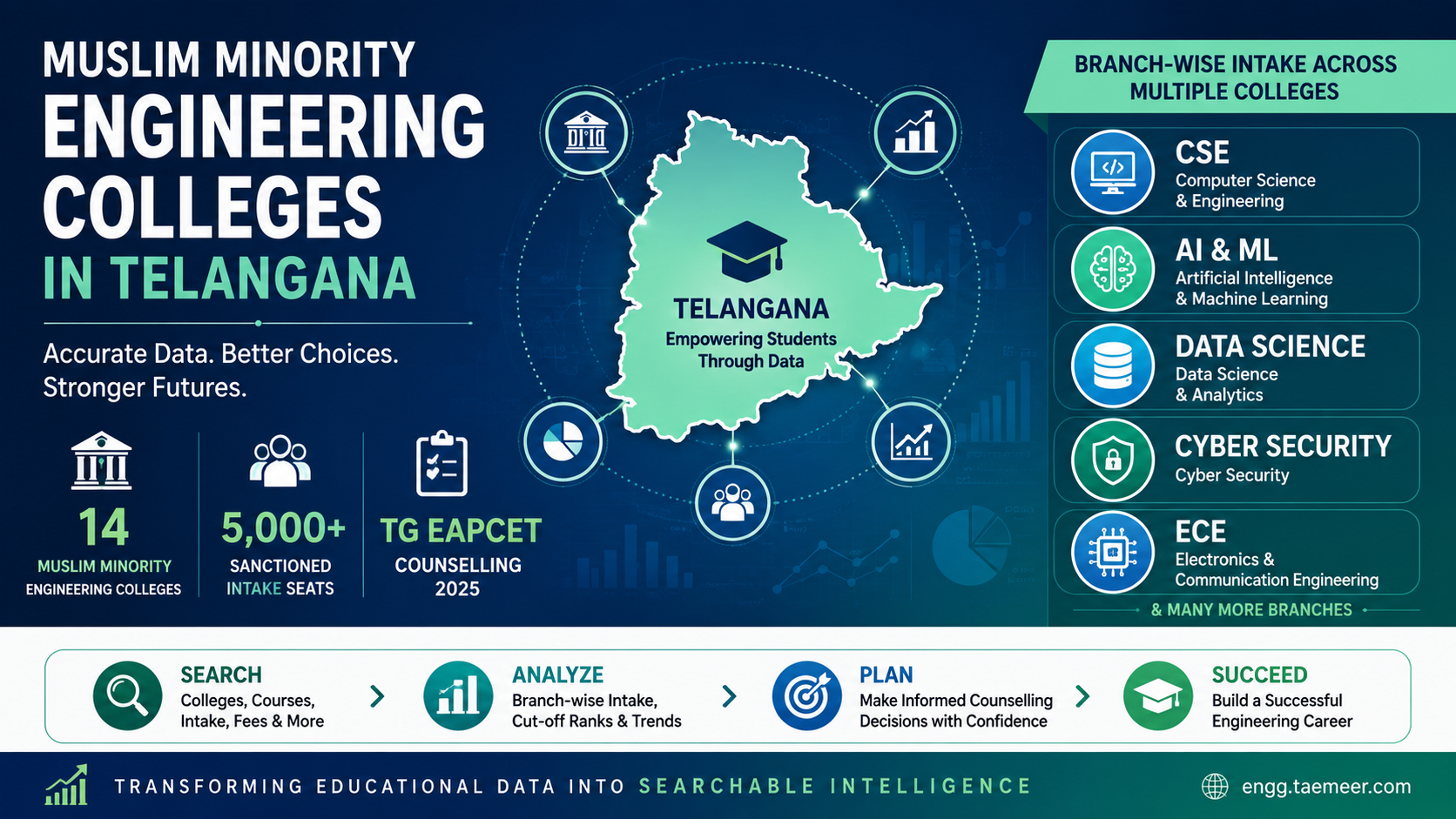
In Telangana, a significant share of engineering seats are offered in Muslim minority engineering colleges. These institutions were set up by Muslim community trusts or societies, and are recognised by the State Government as minority institutions under Article 30 of the Constitution of India. Their goal is to promote access to professional education for students belonging to the Muslim community, while still keeping a portion of seats open to all eligible students on merit.
For TG EAPCET aspirants, the phrase "minority quota" often creates confusion. Many students and parents are unsure whether Muslim candidates must still write TG EAPCET, how many seats are reserved for Muslim students inside a minority college, and whether non‑Muslim students can also get seats in these institutions. This article explains, in simple language, how the minority quota works inside Category‑A seats for Muslim minority engineering colleges in Telangana.
The information here is based on the general rules followed by the Telangana Council of Higher Education (TGCHE) and the counselling process for TG EAPCET, along with public information from college admission pages and minority‑seat notifications. Actual percentages and seat matrices can change from year to year, and students should always refer to the latest TG EAPCET counselling notification and official college prospectus for exact details.
Category‑A and Category‑B seats in private engineering colleges
All private engineering colleges in Telangana (both Muslim minority and non‑minority) follow a common basic structure for seat distribution. In every B.E./B.Tech course, the sanctioned intake is divided into two broad categories:
- Category‑A seats (Convener / TGCHE counselling) – Normally 70% of the sanctioned intake in each course. These seats are filled only through the centralised TG EAPCET counselling conducted by TGCHE, strictly on the basis of rank, local/non‑local status, and reservation rules.
- Category‑B seats (Management quota) – Normally 30% of the sanctioned intake in each course. These seats are filled directly by the college management under Category‑B admission guidelines issued by TGCHE, usually through a separate notification and an online merit‑based process.
This 70:30 split applies to most private self‑financing engineering colleges, whether they are Muslim minority or non‑minority. The difference lies in how Category‑A seats are further earmarked inside a notified Muslim minority college.
How minority reservation works inside Category‑A seats
In a Muslim minority engineering college, Category‑A seats (the 70% block filled via TG EAPCET counselling) are treated in a special way. A substantial portion of these Category‑A seats are reserved for Muslim minority candidates, and the remaining Category‑A seats are open to non‑minority candidates as per the general reservation pattern.
The exact share of seats reserved for Muslim students inside Category‑A varies from college to college and is based on the minority status order and government approvals. In some colleges, almost all Category‑A seats are reserved for Muslim candidates, while in others, a part of Category‑A remains open to non‑minority students. For example, some college prospectuses explicitly state that 100% of Category‑A seats are reserved for Muslim minority candidates, while Category‑B seats follow a different pattern.
However, an important point is that all Category‑A seats in minority colleges are still filled only through TG EAPCET counselling. Muslim students cannot "directly" claim these seats without writing the entrance test and participating in the web‑options process. Minority reservation works inside the government counselling itself, not outside it.
Do Muslim students still need TG EAPCET for minority colleges?
Yes. For most Muslim minority engineering colleges in Telangana, a Muslim student must:
- Appear for TG EAPCET and obtain a valid rank (or satisfy the minimum qualifying criteria notified for that year).
- Register for counselling and give web options, specifically choosing Muslim minority colleges and branches they are interested in.
- Compete for the Muslim minority quota seats against other Muslim candidates, based on TG EAPCET rank and usual reservation rules (local/non‑local, gender, etc.).
The counselling software identifies Muslim candidates (as per the application data) and allocates seats against the minority quota in each college as per the seat matrix and rules notified for that year. If some minority quota seats remain vacant after exhausting eligible Muslim candidates, those seats may be converted to general quota seats as per TGCHE guidelines for that particular counselling round.
Can non‑Muslim students join Muslim minority colleges?
Yes, non‑Muslim students can join Muslim minority engineering colleges in two main ways:
- Through Category‑A seats – A portion of Category‑A seats may be open to non‑minority candidates, depending on the government‑approved seat matrix for that college. These seats are allotted purely on the basis of TG EAPCET rank through the same counselling process.
- Through Category‑B (management) seats – Category‑B seats are filled by college managements under the rules notified by TGCHE (usually merit‑based, sometimes with provision for NRI/NRI‑sponsored seats). These seats are generally open to all eligible candidates, irrespective of religion, unless the specific notification says otherwise.
Thus, while Muslim minority colleges primarily aim to serve the educational needs of the Muslim community, they also admit non‑Muslim students through both the counselling system and management quota, keeping the campus academically diverse.
Why minority quota matters for Muslim students
For a Muslim student in Telangana, the minority quota in engineering colleges offers several advantages:
- Access to a separate pool of seats in Muslim minority colleges, where competition is among Muslim candidates only for those reserved seats.
- An opportunity to secure seats in well‑established minority institutions in and around Hyderabad and other districts, often with good teaching, infrastructure and peer support.
- A structured pathway to professional education that recognises the constitutional right of minorities to establish and administer educational institutions, while integrating them into the mainstream TG EAPCET counselling process.
At the same time, students must remember that a minority quota is not a substitute for exam preparation. TG EAPCET rank still matters, cut‑off ranks can be competitive in popular colleges and branches, and choices should be planned carefully by comparing colleges, courses, fee structures and previous year cut‑offs.
Top Computer-related Engineering Courses in Telangana by TGEAPCET 2025 Cut-Off Ranks.
Muslim minority engineering colleges in Telangana - overview of intake
The following table shows a group of major Muslim minority engineering colleges in Telangana along with the number of B.E./B.Tech courses and total approved intake. These figures are taken from the internal engg.taemeer.com database (sanctioned intake as per recent TG EAPCET counselling data) and are provided here for quick reference.
| College Code | College Name | Total Courses | Total Intake |
|---|---|---|---|
| AIZA | AIZZA COLLEGE OF ENGINEERING AND TECHNOLOGY (AIZA) | 3 | 53 |
| AZAD | AZAD COLLEGE OF ENGINEERING AND TECHNOLOGY (AZAD) | 2 | 76 |
| DCET | DECCAN COLLEGE OF ENGINEERING AND TECHNOLOGY (DCET) | 8 | 441 |
| GKEM | G K INSTITUTE OF ENGINEERING AND TECHNOLOGY (GKEM) | 4 | 168 |
| ISLC | ISL ENGINEERING COLLEGE (AUTONOMOUS) (ISLC) | 6 | 378 |
| JPNH | JAYAPRAKASH NARAYAN ENGINEERING COLLEGE (JPNH) | 4 | 336 |
| LRDS | LORDS INSTITUTE OF ENGINEERING AND TECHNOLOGY (AUTONOMOUS) | 8 | 924 |
| MJCT | M J COLLEGE OF ENGINEERING AND TECHNOLOGY (MJCT) | 7 | 588 |
| MMTZ | MUMTAZ COLLEGE OF ENGINEERING AND TECHNOLOGY (MMTZ) | 4 | 147 |
| NAWB | NAWAB SHAH ALAM KHAN COLLEGE OF ENGINEERING AND TECHNOLOGY (AUTONOMOUS) | 7 | 420 |
| SANA | SANA ENGINEERING COLLEGE (SANA) | 8 | 399 |
| SCET | SHADAN COLLEGE OF ENGINEERING AND TECHNOLOGY (AUTONOMOUS) | 10 | 504 |
| SWET | SHADAN WOMENS COLLEGE OF ENGINEERING AND TECHNOLOGY (AUTONOMOUS) | 6 | 336 |
| VRKW | DR VRK WOMENS COLLEGE OF ENGINEERING AND TECHNOLOGY (AUTONOMOUS) | 6 | 168 |
The intake figures show that Muslim minority engineering colleges in Telangana vary significantly in size and course diversity. Some institutions such as LORDS Institute of Engineering and Technology, M J College of Engineering and Technology and Shadan College of Engineering and Technology offer a broad range of engineering courses with large student intake capacities, while smaller institutions focus on a limited number of specialised programmes. Together, these colleges provide several thousand engineering seats annually through TG EAPCET counselling and management quota admissions.
Branch-wise Intake in Muslim Minority Engineering Colleges
The table below shows the branch-wise sanctioned intake for each Muslim minority engineering college, based on 2025 TG EAPCET counselling data available in the engg.taemeer.com database. This helps students see how many seats are offered in each branch at every college.
| College Code | Branch Code | Intake |
|---|---|---|
| AIZA | CSE | 21 |
| EEE | 11 | |
| MIN | 21 | |
| AZAD | AID | 38 |
| CSE | 38 | |
| DCET | CIV | 42 |
| CME | 42 | |
| CSE | 210 | |
| ECE | 21 | |
| EEE | 21 | |
| ETE | 21 | |
| INF | 42 | |
| MEC | 42 | |
| GKEM | AIM | 42 |
| CSE | 42 | |
| CSI | 42 | |
| INF | 42 | |
| ISLC | AID | 84 |
| CIV | 21 | |
| CSE | 168 | |
| ECE | 21 | |
| INF | 63 | |
| MEC | 21 | |
| JPNH | AIM | 42 |
| CSD | 42 | |
| CSE | 126 | |
| CSM | 126 | |
| LRDS | AIM | 126 |
| CIV | 21 | |
| CSD | 84 | |
| CSE | 378 | |
| CSM | 126 | |
| ECE | 42 | |
| INF | 126 | |
| MEC | 21 | |
| MJCT | CIV | 42 |
| CSA | 42 | |
| CSD | 42 | |
| CSE | 336 | |
| CSM | 42 | |
| ECE | 42 | |
| MEC | 42 | |
| MMTZ | CIC | 42 |
| CIV | 21 | |
| CSE | 42 | |
| CSM | 42 | |
| NAWB | CIC | 42 |
| CIV | 21 | |
| CSD | 21 | |
| CSE | 168 | |
| CSM | 84 | |
| INF | 63 | |
| MEC | 21 | |
| SANA | CIV | 42 |
| CSC | 42 | |
| CSD | 42 | |
| CSE | 126 | |
| CSM | 42 | |
| ECE | 42 | |
| EEE | 42 | |
| MEC | 21 | |
| SCET | AID | 42 |
| AIM | 42 | |
| CIV | 21 | |
| CSD | 42 | |
| CSE | 168 | |
| CSM | 84 | |
| ECE | 21 | |
| EEE | 21 | |
| INF | 42 | |
| MEC | 21 | |
| SWET | AID | 42 |
| CSD | 42 | |
| CSE | 168 | |
| CSM | 42 | |
| ECE | 21 | |
| INF | 21 | |
| VRKW | AID | 21 |
| CSD | 42 | |
| CSE | 42 | |
| CSM | 21 | |
| ECE | 21 | |
| EEE | 21 |
Students are advised to use the Courses Explorer and college pages on this website to see branch‑wise seats, fee structures, cut‑off ranks and detailed information for each minority engineering college before locking their web options.
See also
Top Muslim Minority Engineering Colleges in Telangana - Ranked by EAPCET 2025 Cut-Off.
If you are comparing different minority institutions in Telangana, you may also find this page useful:
Christian Minority Engineering Colleges in Telangana - Colleges and Branch-wise Intake
Frequently Asked Questions on Minority Quota
Q:1. Can I get a "free seat" in a Muslim minority college with a low TG EAPCET rank?
No seat is literally "free" - tuition and other fees are fixed by the government (TAFRC) or by the affiliating university within approved limits. A Muslim minority quota seat in Category‑A means that you are competing in a separate, smaller pool of Muslim candidates, which can improve your chances of getting a seat in a good college or branch even with a comparatively lower rank. It does not remove the need for TG EAPCET or guarantee admission at any rank. Students must still qualify in TG EAPCET, register for counselling, and choose colleges carefully based on previous years’ cut‑off ranks and their own preferences.
Q:2. I am a Muslim student but I studied in another state. Can I still claim minority seats in Telangana?
Minority status (Muslim) and local/non‑local status are handled separately. Being Muslim is relevant for claiming seats in Muslim minority colleges, while local status (Telangana / non‑local) affects how many seats you can compete for in each college. A Muslim candidate from another state may still be considered for Muslim minority seats in Telangana colleges, but will generally be treated as non‑local under the TG EAPCET rules. Such students should carefully read the latest TG EAPCET information booklet and counselling notification to understand how local/non‑local status, minority status and reservation categories are applied together in that year’s seat matrix.
Q:3. If I do not write TG EAPCET, can I still get admission to a Muslim minority engineering college?
For Category‑A seats in Muslim minority colleges, TG EAPCET is almost always compulsory - these seats are filled only through TGCHE counselling. In some years, the government may allow a limited number of Category‑B (management) seats in minority engineering colleges to be filled with candidates who have not written or not qualified in TG EAPCET, but this depends entirely on the specific notification and rules for that academic year. Such admissions usually happen after all eligible entrance‑test candidates have been considered. Students should not depend on this as a primary plan and are strongly advised to appear for TG EAPCET to maximise their options and avoid last‑minute uncertainty.